


Best Cleaning Tablets for Baby Bottles in 2026
Find the best cleaning tablets for baby bottles. Compare formulas, safety standards, and what really works for busy parents in ...

Malaysia opens my.nuviebaby.com, prices in RM.

You're staring at a half-full bottle of expressed breast milk and wondering if you can top it up with formula to make a full feed. Or maybe your supply is running low, and you need to stretch what you have. The short answer: yes, you can mix breast milk with formula, and it's a perfectly safe option when done correctly. But like most things with feeding babies, there's a right way to do it, and a few details worth knowing before you pour.
Life with a newborn rarely goes according to plan. You might have started with exclusively breastfeeding, but supply issues, returning to work, or sheer exhaustion have changed the picture.
Mixing breast milk with formula, often called combination feeding, happens for loads of practical reasons:
None of these reasons make you less committed or less capable. They make you a parent dealing with reality. Combination feeding can offer flexibility that keeps both you and your baby fed and functioning.

The straightforward answer is yes, mixing breast milk with formula is safe. Both the American Academy of Pediatrics and pediatricians worldwide confirm there's no medical reason to keep them separate.
Your baby's digestive system handles both liquids without issue. Breast milk and formula don't chemically react or become dangerous when combined. The nutrients from both remain intact.
But here's what matters: how you prepare each component before mixing. Formula needs to be made according to packet instructions with the correct water-to-powder ratio. Breast milk needs proper handling and storage. Get those basics right, and the combination is perfectly fine.
Some parents worry that mixing the two reduces the benefits of breast milk. That's not how it works. Every drop of breast milk provides antibodies and nutrients, whether it's in a bottle by itself or combined with formula.
There's a right sequence to follow. Don't wing this part.
Always make the formula exactly as the packet instructs. Use the correct amount of water for the number of scoops. This isn't negotiable. Too concentrated or too diluted formula can harm your baby.
Once the formula is properly mixed and at the right temperature, then add the breast milk.
Never use breast milk as the liquid to mix formula powder. This throws off the concentration and wastes the nutritional value of your expressed milk.
Pour your prepared, correctly mixed formula into the bottle first. Then add the breast milk. Swirl gently to combine. That's it.
Breast milk can be added cold, at room temperature, or warmed. Formula should be at the temperature your baby prefers (most parents go with lukewarm).
If you're warming the mixture, do it after combining. Never microwave. Use a bottle warmer or a bowl of warm water. Test the temperature on your wrist before feeding.
| Step | Action | Why It Matters |
|---|---|---|
| 1 | Prepare formula with correct water ratio | Ensures proper nutrition and digestion |
| 2 | Allow formula to reach safe temperature | Prevents burns and makes mixing easier |
| 3 | Add breast milk to prepared formula | Maintains breast milk integrity and formula concentration |
| 4 | Swirl gently to combine | Mixes without damaging nutrients |
| 5 | Test temperature before feeding | Ensures baby's safety and comfort |
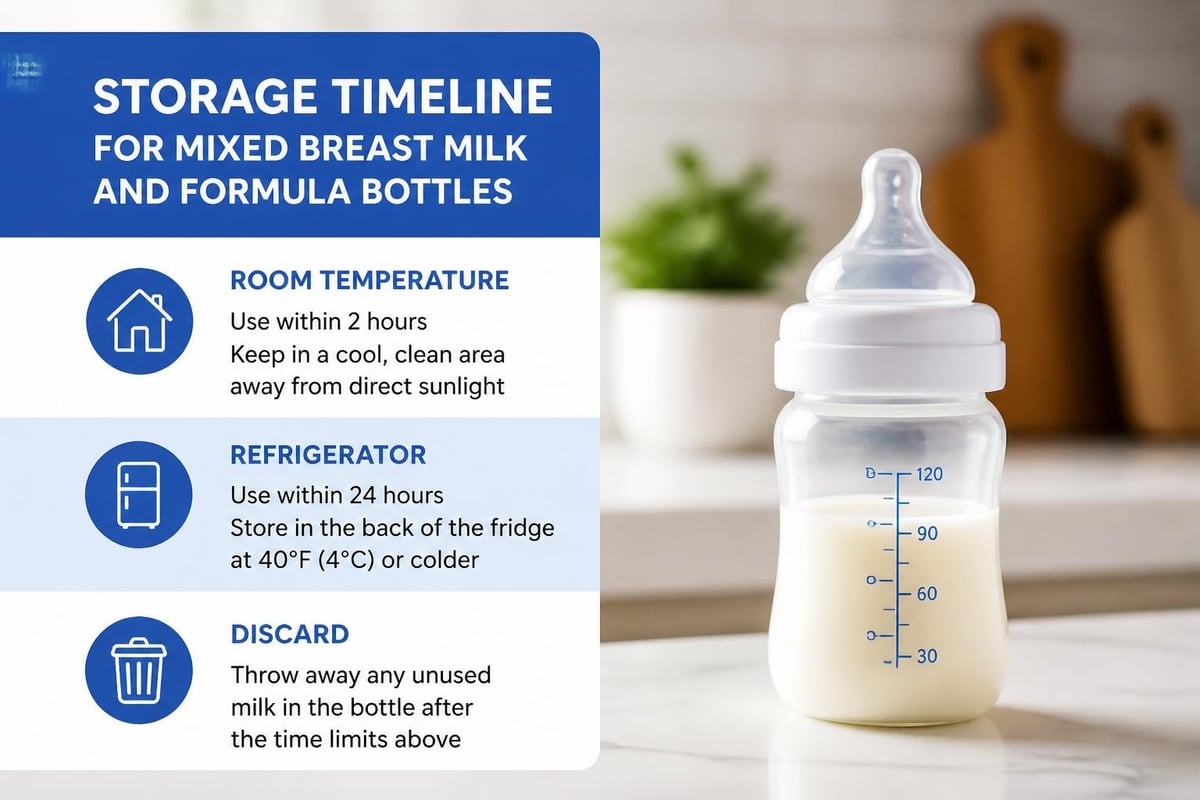
Mixed bottles follow the strictest storage rule of whichever component expires first.
Formula is the limiting factor. Once formula is prepared, it needs to be used within two hours at room temperature or 24 hours in the fridge. When you add breast milk to prepared formula, those same limits apply to the entire mixture.
Freshly expressed breast milk can normally sit at room temperature for up to four hours and in the fridge for up to four days. But once mixed with formula, you're bound by formula's shorter timeline.
You're sleep-deprived and working on autopilot. These errors happen more often than you'd think.
Using breast milk to mix formula powder is the biggest one. It seems logical but it's wrong. The formula won't be properly concentrated, and you're diluting the breast milk unnecessarily.
Saving leftover mixed bottles is another trap. If your baby doesn't finish a mixed bottle, you need to toss it within an hour of starting the feed. Yes, it feels wasteful. No, you can't save it. Bacteria from your baby's saliva multiplies quickly in milk.
Preparing too far in advance creates storage headaches. Make mixed bottles fresh when possible, or prepare formula ahead and add refrigerated breast milk just before feeding.
When you're washing multiple bottles daily, keeping them clean and sterile matters even more with combination feeding. Bottles used for both breast milk and formula need thorough cleaning after every use, and proper sterilisation helps prevent contamination.
You'll go through bottles faster when you're combination feeding. More feeds, more bottles, more washing.
Between expressing, storing breast milk, preparing formula, and mixing feeds, you might be washing 8 to 12 bottles and pump parts daily. It's relentless.
Whether you're sterilising bottles in boiling water or using a dedicated system, the routine becomes a second job. Many parents doing combination feeding end up with a larger rotation of bottles just to keep up with demand.
For parents who want one less thing to do, the nuviebaby Clean™ washes, steam-sterilises, dries, and stores up to 8 bottles and pump parts in one cycle. It's built specifically for this kind of relentless workload, handling both bottles and pumping equipment without you standing at the sink three times a day.
Sometimes mixing makes sense. Sometimes it doesn't.
Mix when:
Keep separate when:
Most babies handle mixed feeds without any issues. The combination doesn't inherently cause gas, constipation, or upset stomachs.
But if your baby has trouble with formula alone, mixing it with breast milk won't magically fix that. Formula can affect digestion differently than breast milk, and some babies need time to adjust or a different formula type.
Watch for the usual signs: excessive fussiness, changes in stool (harder, different colour), unusual gas, or spit-up. If these appear after introducing mixed feeds, talk to your pediatrician. It might be the formula itself, not the mixing.
Some parents find that gradually increasing the ratio of formula to breast milk over several days helps their baby's system adjust more smoothly.
There's no single right way to combine breast milk and formula. Some parents breastfeed during the day and give formula at night. Others do the reverse. Some mix every bottle; others alternate.
Your approach depends on:
The goal isn't perfection. It's keeping your baby fed and yourself functioning. If that means three breastfeeds and two formula bottles a day, fine. If it means one bottle of each mixed together at bedtime, also fine.
If you're still breastfeeding or pumping, adding formula doesn't mean your supply has to disappear.
Milk production works on supply and demand. The more you remove, the more you make. If you replace breastfeeds or pumping sessions entirely with formula, your supply will drop. That might be exactly what you want, or it might not.
To maintain supply while combination feeding:
If you're planning to wean gradually, combination feeding is an excellent bridge. You can slowly reduce breastfeeds while increasing formula until you reach whatever balance works.
Not all formulas are identical. When you're mixing with breast milk, you want one that your baby tolerates well and that matches their needs.
Types to consider:
Your pediatrician can guide you, especially if your baby has specific dietary needs or if you're choosing formula to complement breast milk for medical reasons.
Once you find a formula that works, stick with it. Switching brands constantly can upset your baby's digestion more than the actual combination feeding.
Formula feeding creates waste. There's no getting around that. Tins, bottles, water usage, energy for sterilisation and washing.
If environmental impact matters to you, there are small things that help. Buying larger tins reduces packaging waste. Some brands offer more sustainable packaging options. When you're washing bottles and equipment, using efficient methods saves water and energy.
For parents looking to reduce their environmental footprint in other areas of baby care, choosing products from companies that prioritise sustainability can make a difference. Brands like Tinc focus on eco-friendly, plastic-free products that support a greener lifestyle without compromising on what you need.
Your baby doesn't care whether the bottle contains breast milk, formula, or both. They care about being fed when hungry.
Watch for hunger cues: rooting, sucking on hands, fussiness, turning toward the breast or bottle. Feed responsively, whether it's a mixed bottle or not.
Some babies reject mixed bottles initially if the taste is different from what they're used to. Start with a higher ratio of breast milk to formula and gradually shift the balance over a week or so.
Others drink mixed bottles without batting an eye. Every baby is different. Trust what works for yours and adjust accordingly.
Tracking two different feeding methods is extra mental work. You're managing supply, pumping schedules, formula prep, storage rules, and bottle washing all at once.
Write things down. Use your phone, a notebook, whatever works. Track when you pumped, how much you got, when you made formula, when feeds happened. You won't remember, especially at 3 a.m.
Share the load if you can. If a partner or caregiver is helping with feeds, make sure they know the mixing rules and storage limits. Leave clear instructions and labeled bottles.
And give yourself permission to simplify. If combination feeding is making life harder instead of easier, reassess. Maybe all formula some days is fine. Maybe all breast milk other days. Flexibility is the entire point.
Most combination feeding happens without needing medical input. But reach out if:
Your pediatrician can also help if you're struggling with supply and want guidance on maintaining breastfeeding while supplementing with formula.
There's a strange guilt that comes with feeding decisions. You might feel like you're failing if you can't exclusively breastfeed. Or that you should be trying harder to pump more.
Here's the truth: can I mix breast milk with formula isn't a question about failure. It's a question about feeding your baby in a way that works for your specific circumstances. Every family's situation is different.
Your baby needs to be fed. You need to be functional. Combination feeding can be the solution that makes both possible. There's no award for suffering through an approach that's not working just because it's considered "best."
The best feeding method is the one that keeps your baby healthy and you sane. If that's a mix of breast milk and formula, you're doing it right.
Mixing breast milk with formula is safe, practical, and common. Prepare formula correctly, add breast milk second, follow storage rules, and feed your baby responsively. If you're drowning in bottle washing from combination feeding, nuviebaby was built by parents who understand that relentless cycle and created a machine to take it off your plate entirely.
Find the best cleaning tablets for baby bottles. Compare formulas, safety standards, and what really works for busy parents in ...

Looking for an avent bottle cleaner solution? Learn the best cleaning methods, products, and what actually works for Avent bott...

White spots or cloudy film on bottles after washing? It's mineral deposit from tap water, and in most cases you can sort it out...

